
Strokes to Prevent a Stroke Attack
Most men think stroke is something that happens to their fathers. In Singapore, 1 in 4 stroke patients are under 60. In this article, Kumar breaks down why midlife men are more vulnerable than they realise, and the one simple activity proven to reduce your risk by 33%.
5/22/20266 min read

Strokes to Prevent a Stroke Attack
By Kumar | The Midlife Frontier™
You have probably heard a version of this story before.
A man in his early fifties. Healthy enough by most standards. Still working hard, still showing up, still doing what he has always done. No obvious warning signs that anyone could point to.
Then one ordinary morning, something happens. Maybe his arm goes numb. Maybe his speech suddenly slurs. Maybe he collapses in the bathroom before anyone in the house is even awake.
A stroke.
And the people around him are left asking the same question every single time.
How did we not see this coming?
I want to talk about that question. Because the answer matters deeply, especially if you are a man between 45 and 62, navigating the pressures of midlife in Singapore right now.
This Is Not Just a Story About Older Men
Here is the part that most people do not realise until it is too late.
According to the National Neuroscience Institute Singapore, 1 in 4 stroke patients in Singapore are under 60.
One in four. Not a handful. A quarter of the people sitting in stroke wards across this country are in the same decade that many of us are living in right now. They are still in the middle of their careers. Still raising families. Still planning their next chapter.
Singapore sees approximately 26 strokes every day, according to the Singapore Heart Foundation. Stroke is the fourth leading cause of death in this country and one of the leading causes of long-term disability.
These are not distant numbers. They are happening around us, to people like us, more often than we want to believe.
And the most frightening part is this.
Singapore's National Population Health Survey found that 1 in 3 Singaporeans aged 18 to 69 has high blood pressure. Hypertension. The single biggest driver of stroke. And a significant proportion of them do not know it, because hypertension does not hurt. It does not announce itself. It builds quietly in the background while you keep going about your life.
That is why they call it the silent killer.
Why Midlife Men Are Especially Vulnerable
I want to be honest with you here, because I think this conversation deserves honesty.
Midlife is not just a time of career transition or identity shift. It is a time when your body is dealing with a specific set of physiological pressures that stack on top of each other in ways that significantly raise your risk.
Think about what is happening in the body of a typical mid-career professional right now.
Years of sustained work pressure have kept cortisol levels elevated. Chronically high cortisol raises blood pressure, promotes inflammation in the arteries, and accelerates the stiffening of blood vessel walls. Arterial stiffness is not just something that happens to elderly men. It is measurable and documented in men in their late forties who have spent years under high occupational pressure without enough recovery time built in.
Add disrupted sleep to that. HPB's national health data shows that 44% of Singapore adults are not getting the recommended 7 to 9 hours of sleep per night. Poor sleep raises blood pressure. It disrupts the body's ability to repair its vascular system overnight. It elevates the inflammation markers that quietly damage arteries over years.
Then factor in testosterone decline, which begins for most men around 40. Lower testosterone is associated with increased visceral fat, reduced insulin sensitivity, and poorer cardiovascular outcomes. It is not a dramatic event. It is a gradual shift that changes the body's internal environment in ways that matter for stroke risk.
And then there is the thing that almost no one talks about in a corporate Singapore context.
What does years of sitting at a desk, back to back meetings, no real physical outlet, and no genuine recovery actually do to a cardiovascular system over time?
The answer is not comfortable. The heart and arteries deteriorate quietly and consistently under those conditions. They do not complain until they fail.
I am not saying this to frighten you. I am saying it because I genuinely believe that most men in midlife have not been given this picture clearly. And they deserve to have it.
One Activity. Simple. Proven. Available to Almost Everyone.
Here is the good news, and I want you to hold onto it.
There is one activity with strong, consistent research behind it that directly addresses stroke risk. Not in a vague, general "exercise is good for you" way. Specifically, measurably, and with mechanisms that map directly to the physiological risks I have just described.
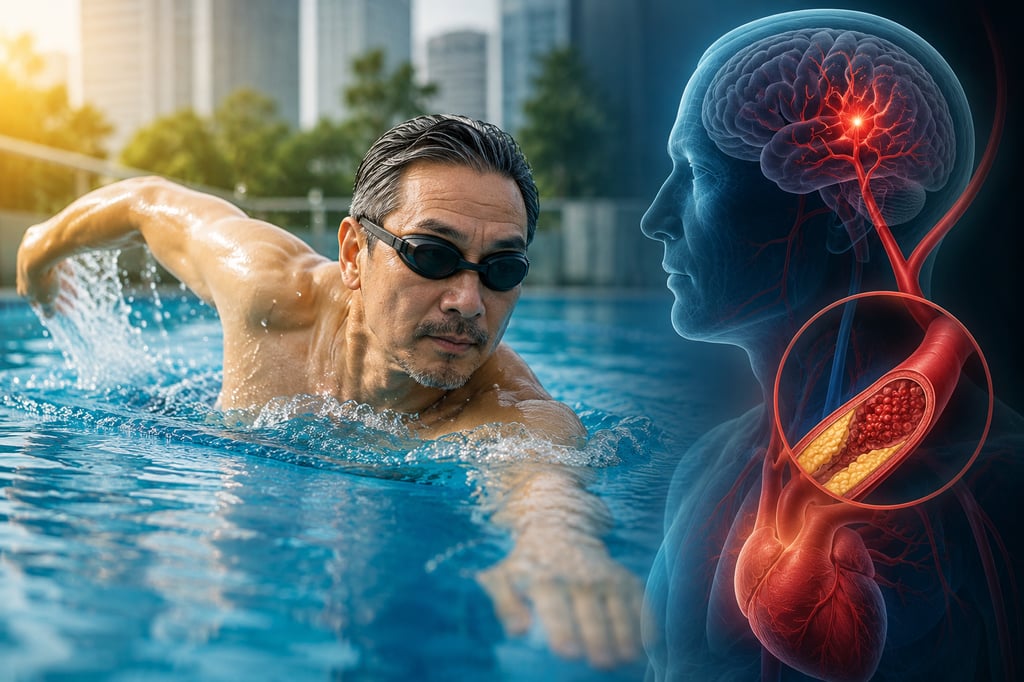
That activity is swimming.
A major longitudinal study found that regular swimmers have a 33% lower risk of dying from stroke or cardiovascular disease compared to people who are sedentary. Thirty-three percent. That is not a marginal improvement. That is a significant, life-changing reduction in risk from an activity that does not require a gym membership, a personal trainer, or a prior level of fitness.
Let me tell you exactly why swimming works for this, because I think it matters to understand the why rather than just be handed a recommendation.
Swimming lowers blood pressure structurally, over time. Not just during the session, but through the consistent training it gives the heart to pump more efficiently. For a man who is hypertensive or trending towards hypertension, this directly addresses the number one mechanism of stroke.
Swimming reduces arterial stiffness. The continuous cardiovascular demand of moving through water improves the elasticity of blood vessels. This is not a small thing. Rigid, stiff arteries are one of the most documented early warning signs of stroke risk in midlife males, and swimming is one of the most accessible exercises available that genuinely addresses it.
Swimming improves blood flow to the brain. The brain is protected not just by preventing blockages, but by maintaining consistent, oxygen-rich supply. Swimming does this effectively over extended periods in a way that high-impact exercise often cannot sustain for deconditioned bodies.
Swimming reduces cortisol. This is the stress link, and it is important. Swimming is one of the most effective exercises for bringing chronic cortisol levels down, not just during the session but in the hours that follow. For a man carrying years of occupational stress in his body, this is a direct intervention.
And here is the thing I want you to hear clearly.
Swimming is forgiving. The water carries your weight. There is no impact on your knees, your hips, your lower back. A 54-year-old who has not exercised properly in a decade, who is carrying extra weight, who feels embarrassed about his fitness level, can get into a pool and begin. That first lap does not have to be fast. It does not have to be long. It just has to happen.
Singapore makes this accessible. Almost every HDB estate has a public pool nearby. ActiveSG pools cost a few dollars per entry. The infrastructure is there. The barrier is not the pool.
The Gap We Need to Talk About
I work with mid-career professionals who are intelligent, driven, deeply capable men.
And I see the same pattern repeatedly.
They know they should be moving more. They know the lifestyle they have built around performance and output comes at a cost. They have felt the warning signs in their bodies for a while. The disrupted sleep. The tension they carry that never fully releases. The energy that is not quite what it used to be.
But the urgency has not arrived yet.
And so they wait.
Stroke is the kind of event that creates urgency in the worst way possible. In a moment, without warning, it can take from a man the very things he has spent his entire career building. His ability to lead. His ability to provide. His independence. His presence in the lives of the people he loves.
We hear the stories. The man who was fine on Monday and hospitalised on Tuesday. The one who survived but never went back to the role he held. The one his family did not see coming.
These stories are not rare anymore.
And the hardest part is knowing that many of them were preventable.
What I Want You to Do After Reading This
I am not asking you to overhaul your life.
I am asking you to think about one thing you can do this week.
Three sessions in the pool. Thirty minutes each. Any pace. That is the evidence-based threshold where the protective effects on blood pressure and arterial health begin to compound over time.
If three feels like too much, do two. If thirty minutes feels long, do fifteen. The point is not perfection. The point is the beginning of a consistent, sustainable habit that is doing something real inside your body every single time you do it.
Your health is not a reward you earn at the end of a career. It is the foundation on which everything else in your life stands.
Protect it the same way you protect everything else that matters to you.
And If You Want to Understand the Full Picture
Stroke risk is one part of a broader midlife wellness landscape that most men have not looked at clearly.
I built a free assessment specifically for mid-career professionals. It covers four dimensions of your wellbeing across physical, emotional, mental, and physiological health. It takes five minutes. No email required. And it gives you an honest picture of where you are right now, before things become urgent.
Take the free Midlife Frontier Wellness Audit here:
https://the-midlife-frontier-wellness-audit.netlify.app/
Because the best time to pay attention to your health is before your body forces the conversation.
Kumar is the founder of The Midlife Frontier™, a structured reinvention and wellness support system for mid-career professionals navigating the pressures of midlife. He spent 28 years as a military officer before building this mission from the ground up. His work sits at the intersection of physiological wellness, emotional resilience, and practical reinvention for men aged 45 to 62.
Connect with Kumar on LinkedIn: https://www.linkedin.com/in/s-kumar74
Begin Your Frontier
Real change begins with clarity, not pressure.
Let’s start with a grounded conversation.
© 2026. All rights reserved.
Contacts
themidlifefrontier@gmail.com
+65 80206769
Opening hours
Monday - Friday: 9:00 - 18:00
Saturday: 9:00 - 12:00
Sunday & Public Holidays : Closed